
Working Well Across Time Zones
A nine-hour offset does not break a team because of the hours. It breaks it because the habits that worked when everyone shared a corridor quietly stop working, and nobody notices for a month.
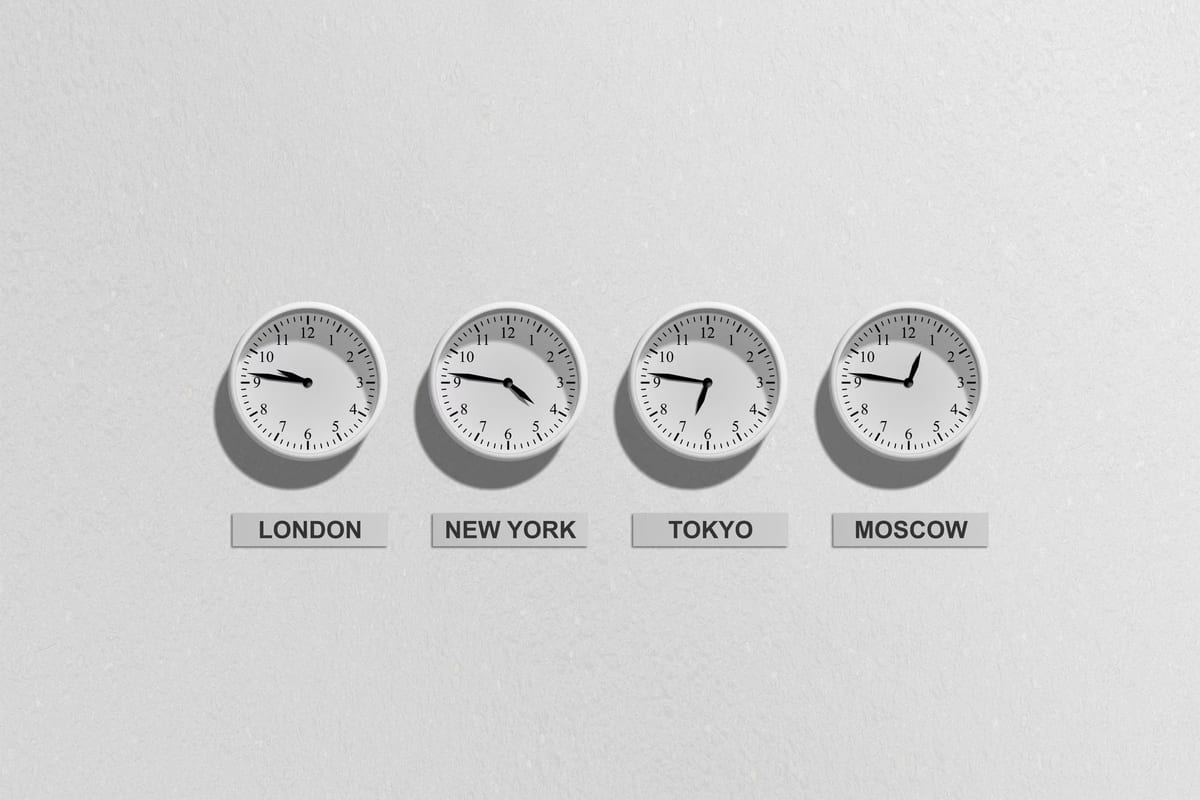
Do the overlap arithmetic honestly
Start by writing down the actual overlap in hours, not the theoretical one. Chicago and Lisbon share a comfortable afternoon. Chicago and Bangkok share almost nothing that is civilised at both ends. Berlin and Buenos Aires have a workable morning-to-afternoon window that vanishes twice a year when daylight saving shifts on different dates in each hemisphere.
That last point catches out more teams than any other. The United States moves its clocks on the second Sunday in March and the first Sunday in November; the European Union moves on the last Sunday in March and the last Sunday in October. For several weeks a year, the offset between a US and a European colleague is one hour different from what everyone's mental model says. Southern-hemisphere countries move in the opposite direction entirely, and many countries do not observe it at all.
The fix is boring and effective: never write a time without its zone, use the IANA zone name rather than an abbreviation when it matters, and let the calendar do the conversion rather than doing it in your head.
Make written handovers the default
When overlap is short, the meeting is the wrong container for information. A team that runs on calls will lose most of a day every time a question needs an answer from someone who is asleep. The alternative is a handover written at the end of each working day: what moved, what is blocked, what the next person should pick up, and what decision you would like made while you are offline.
This feels like overhead for about two weeks and then becomes the thing that makes the arrangement viable. It also produces a written record, which is worth a great deal when a decision needs revisiting three months later and the only account of it was a video call nobody recorded.
- Write decisions, not discussions. The useful artefact is what was decided and why, in a few lines, somewhere findable.
- State the deadline in a zone. "By end of Thursday" means three different moments to three colleagues.
- Ask questions that can be answered without you. A question with two proposed answers gets resolved overnight; an open one waits for the next overlap.
- Use ISO dates. 2026-09-04 is unambiguous; 04/09/2026 is not, and half the world reads it the other way round.
Keep exactly one recurring synchronous meeting, and rotate which side of the team takes the awkward hour. A single well-run weekly call at an inconvenient time is far more sustainable than three convenient ones that only half the team can attend.
Defend the edges of your day
The most common failure of time-zone work is not missed meetings; it is a working day that quietly stretches to fourteen hours because there is always someone awake somewhere. Two boundaries prevent it. Decide when you stop being reachable, publish it, and hold to it. And put your genuinely difficult work in the hours before the overlap begins, not after it ends, so that the demanding part of the day happens when your attention is intact.
Notification hygiene is the other half. Set your working hours in the calendar and in the chat tool so that colleagues see a status rather than guessing. Schedule outgoing messages to land in the recipient's morning rather than their midnight; most tools support it, and it stops your Tuesday evening from being someone else's interruption.
Asynchronous work is not slower work. It is work whose latency is visible, which is uncomfortable — and much easier to fix than latency you cannot see.
The connectivity half of the problem
Video calls are the one activity where a travelling worker's connection is genuinely tested, and the thing that fails is almost always the upstream. Your download can be excellent while your upload is not, and a call degrades on the leg that carries your camera. Test both before a call that matters, and turn your camera off without apology when the connection is marginal — audio survives far more packet loss than video.
If a call is load-bearing, do not rely on a single network. A hotspot from a mobile profile as a fallback to building Wi-Fi, or a second profile on a different partner network, converts a disaster into an interruption. It is also worth knowing where your data actually goes: tethering a laptop into a call for an hour is a substantial part of a small allowance.
Meeting hygiene that survives an offset
Write an agenda in the invitation, because someone joining at six in the morning deserves to know whether they need to be there. Record and summarise, so that the person who could not attend is not punished for geography. Finish with explicit owners and dates rather than a vague sense of agreement — vagueness that gets resolved in a corridor at headquarters simply does not get resolved at all when the corridor is nine time zones long.
And keep the meeting short. A ninety-minute call at a bad hour is not a meeting; it is an endurance test that produces worse decisions than a written thread would have.
What good looks like after three months
You can tell a team has adapted when questions get answered while their author sleeps, when nobody asks what time a deadline means, and when the weekly call is about judgement rather than status. That state is reachable in a quarter, and almost never reached by accident. It requires someone deciding that written-first is the norm and then holding the line for the two uncomfortable weeks before it becomes habit.